

Migration can mean much more than moving from one country to another. For many people, it can mean adapting to a new language, new rules, new ways of working, new support systems, and often an immigration process filled with uncertainty. Along the way, the body also speaks. Sometimes it does so through exhaustion. Other times, through insomnia, tension, pain, anxiety, or the feeling of being constantly on alert.
That is why talking about migration trauma is not only about what a person experienced before arriving in their host country. It is also about how those experiences may continue to affect their physical, emotional, and relational health.
In addition, in some immigration cases, mental health evaluations can help document the emotional impact of difficult experiences. These evaluations do not replace the work of immigration attorneys. However, they can complement it by providing important clinical information for people who are seeking to regularize their immigration status in the U.S.
Important note: This is not legal advice. For specific decisions, it is best to consult with your immigration attorney.
The impact of the migration process on physical and emotional health
The migration process can carry a significant emotional weight. It is not always about one traumatic event. Many times, distress builds through an accumulation of fear, loss, change, financial pressure, family separation, or uncertainty about the future.
In episode 7 of Impacto Migrante, Carla Parola speaks with Sanjog, an anthropologist, therapist, and Kundalini Yoga instructor. Sanjog is part of the founding facilitator team of Compassionate Inquiry, the therapeutic model developed by Dr. Gabor Maté and Sat Dharam Kaur.
Throughout the conversation, the body appears as an important place to understand trauma. Not from an alarmist perspective, but through a deeper question: what might the body be expressing when a person can no longer carry so much stress?
In this sense, I believe this question matters, especially because many immigrants do not come to therapy saying, “I have trauma.” Sometimes, they come in saying, “I can’t sleep,” “my body hurts,” “I have trouble breathing,” “I feel exhausted,” or “I don’t understand why I feel this way.” (Source: World Health Organization)
Adapting to a new country can also create emotional strain
Adapting to a new country can be a growth experience. However, it can also create emotional strain.
In many cases, an immigrant has to learn how to function quickly. They may need to figure out work, housing, school, language, transportation, paperwork, and documentation. At the same time, they may be dealing with grief, family separation, or fear related to their immigration status.
In addition, many people feel they cannot stop. They need to keep working, caregiving, and solving problems. As a result, the body can become secondary.
Over time, that level of demand can turn into fatigue, irritability, muscle tension, or difficulty resting. That is why adapting does not always mean being well. Sometimes, it means surviving with the resources available.
Stress, fear, and uncertainty: how they affect the body
Stress does not happen only in the mind. It also activates physical responses. When a person perceives danger, the body may prepare to react. The heart beats faster, breathing changes, muscles tense, and the nervous system becomes alert.
This response can be useful in specific situations. However, when fear continues for a long time, the body may begin to live as if the threat never ends.
The American Psychological Association explains that stress can affect different systems of the body, including the muscular, respiratory, cardiovascular, gastrointestinal, and nervous systems. (Source: American Psychological Association)
In the immigration context, that activation may be connected to many concerns. For example, fear of deportation, family separation, immigration interviews, financial difficulties, or memories of previous experiences.
For this reason, migration-related stress should not be minimized. Even when a person “keeps functioning,” their body may still be carrying deep tension.
The body as an indicator of emotional distress
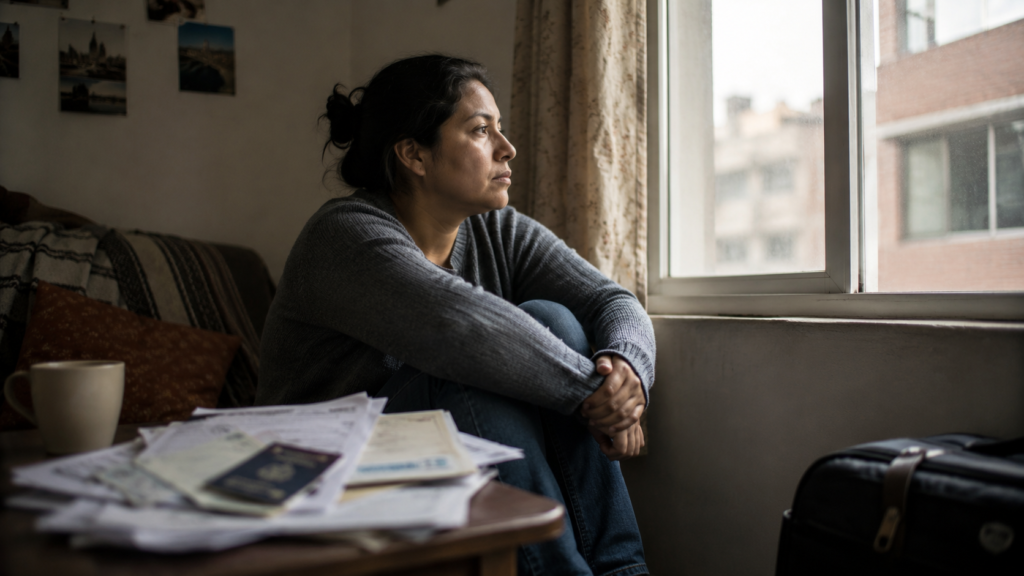
The body can become an important indicator of emotional distress. This does not mean that every physical symptom has an emotional cause. It also does not mean that a person should stop seeking medical care.
However, in many cases, the body offers signals that are worth listening to. This is especially true when symptoms appear or become stronger during moments of pressure, fear, or uncertainty.
That is why an integrated perspective can be helpful. A migrant’s well-being does not depend only on their legal situation. It is also connected to their story, support system, physical health, rest, and sense of safety.
Physical and emotional signs worth paying attention to
Migration-related stress can show up in different ways. Some people experience anxiety, sadness, or irritability. Others notice constant fatigue, headaches, neck tension, digestive issues, or trouble sleeping.
Changes in concentration, emotional sensitivity, isolation, frequent crying, or feeling disconnected may also appear.
In this sense, it is important to remember that these symptoms are not signs of weakness. Many times, they are understandable responses to experiences of pressure, loss, or ongoing threat.
In some immigration cases, a mental health evaluation can help identify and document this impact. This may be especially relevant when the migration history includes violence, persecution, family separation, intense fear, or trauma.
Why the body may stay on alert after migration
Sometimes, a person arrives in a safer place, but their body does not calm down right away. This can feel confusing. The person may wonder, “Why do I feel this way if I already left that situation?”
One possible explanation is that the nervous system needs time to recognize that the danger has passed. When someone has lived on alert for a long time, the body may continue expecting a threat, even when the current environment is more stable.
In addition, the migration process can bring new sources of stress. Arriving in the United States does not always mean feeling fully safe. There may be legal uncertainty, language barriers, financial fear, or lack of family support.
That is why symptoms may appear after migration. Sometimes, they come up when the person finally slows down. Other times, they appear when someone has to tell their story, prepare an immigration case, or face an important interview.
Living in survival mode and its consequences
Living in survival mode means functioning from urgency. The person does what they need to do to keep going, but often without space to feel, rest, or ask for help.
In the short term, this response can help. It allows the person to handle immediate problems. However, when it continues for months or years, it can affect emotional and physical health.
For example, someone may get used to sleeping very little, ignoring pain, avoiding difficult conversations, or disconnecting from their own needs. Over time, this can increase exhaustion, anxiety, or a sense of emptiness.
In addition, many immigrants learn to appear strong so they do not worry their family or because they are supporting others. However, that strength also needs support. Seeking help does not mean giving up strength. On the contrary, it can be a way to care for the body, the story, and the future.
Compassionate Inquiry: exploring the story behind the symptom
Dr. Gabor Maté describes Compassionate Inquiry as a therapeutic method that helps reveal what lies beneath the appearance a person presents to the world. This approach offers a trauma-informed lens that seeks to understand what may be behind symptoms, emotional responses, and patterns of behavior. It is not about judging the person. It is about carefully exploring which experiences may have shaped the way they learned to protect themselves. (Source: Dr. Gabor Maté)
This approach can be especially valuable when talking about migration. Many immigrants have had to adapt quickly, hide fear, hold pain inside, or keep moving forward without enough support.
In that context, a symptom can be understood as a signal that deserves attention. Not to romanticize suffering, but to open a clinical question: what needs to be heard, understood, or supported?
The role of therapeutic support for immigrants
Therapeutic support can help an immigrant understand what they are feeling, organize their story, and recognize how stress has affected their body and emotional health.
In addition, in certain immigration cases, a mental health evaluation for immigration can document symptoms related to anxiety, depression, post-traumatic stress, insomnia, intense fear, or emotional impact from difficult experiences.
For immigration attorneys, working with mental health professionals can provide a clinical perspective that complements the legal strategy. This collaboration helps present not only the facts, but also the human and emotional impact of what the person has lived through.
At the same time, for the immigrant, professional support can offer a safe space. A space where they do not have to prove their strength all the time. A space where their body, their story, and their experience can be heard with respect.
The body may say “no” when something has been too much. Listening to it can also be part of the recovery process.